Jevons Paradox states that increases in the efficiency with which a resource is used can lead to an overall increase in that resource’s consumption rather than a decrease. The concept was identified by the 19th-century British economist William Stanley Jevons, for whom the theory is named. Jevons introduced the paradox in his 1865 book The Coal Question, in which he examined British economic growth and its dependence on coal. He observed that improvements in the fuel efficiency of steam engines lowered the effective cost of coal, which in turn stimulated demand and led to higher total coal consumption. As a result, the efficiency gains were offset by increased use.
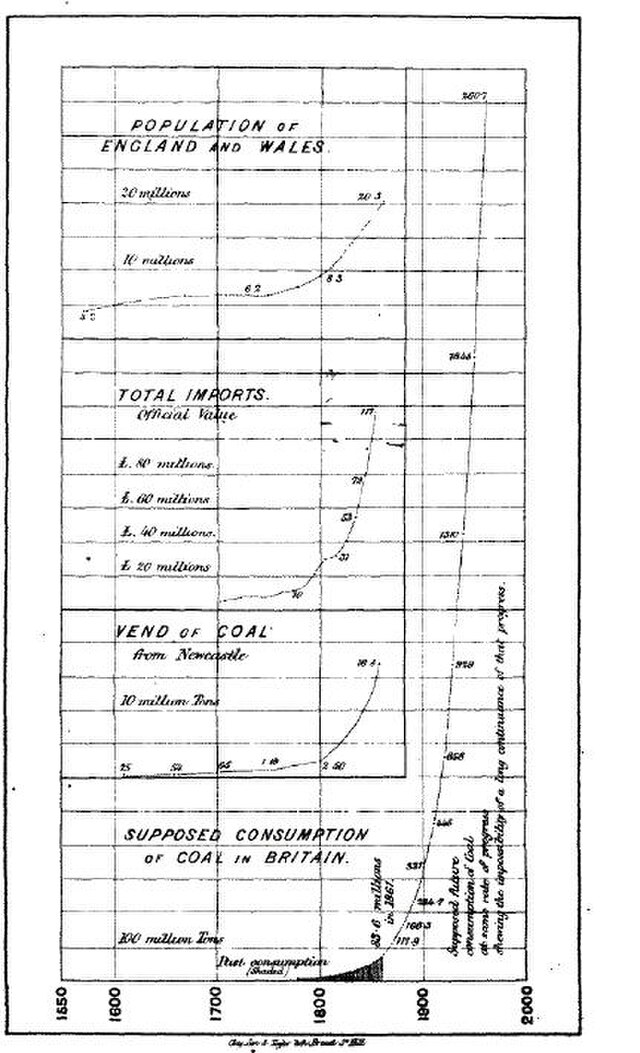
His ideas were later taken up by mid-20th-century geologist M. King Hubbert, who introduced the theory of “peak oil,” which holds that economic growth will eventually be constrained by the depletion of oil reserves. Both Jevons’s and Hubbert’s perspectives emerge from 19th- and 20th-century capitalist frameworks that interpret economic development through the lens of resource scarcity.
In contrast, proponents of permacomputing mobilize this principle as a critique of capitalism. A contemporary example of the paradox can be seen in the proliferation of hyperscale data centers built to support generative AI systems. In this context, gains in computational efficiency do not curb resource consumption but instead accelerate it, driving higher energy use, material extraction, and infrastructural expansion. Efficiency is framed as a technical fix to fundamentally political questions about how computing is organized and to what ends, without questioning the extractive business model.
Sources:
Frase, P. (2016). Four Futures: Visions of the World After Capitalism. Verso.
Jevons S. (1865), The Coal Question: An Inquiry Concerning the Progress of the Nation
and the Probable Exhaustion of Our Coal-Mines, London: Macmillan.
Jevons paradox. permacomputing. https://permacomputing.net/Jevons_paradox/